Classical Music
Chanticleer - Mexican Baroque: Music From New Spain (1994) Music
Posted by Designol at Nov. 5, 2026

Chanticleer - Mexican Baroque: Music From New Spain (1994)
EAC | FLAC | Tracks (Cue&Log) ~ 255 Mb | Mp3 (CBR320) ~ 136 Mb | Scans included
Classical, Choral | Label: Teldec Classics | # 4509-96353-2 | Time: 00:57:41
EAC | FLAC | Tracks (Cue&Log) ~ 255 Mb | Mp3 (CBR320) ~ 136 Mb | Scans included
Classical, Choral | Label: Teldec Classics | # 4509-96353-2 | Time: 00:57:41
In 17th and 18th century New England, transplanted Englishmen like Daniel Read, Abraham Wood, and especially William Billings were composing beautiful but rough-hewn and distinctly American vocal music for use in what were called "singing schools." Far to the west and south, in what was then called New Spain and would later be called Mexico, natives and transplanted Spaniards were composing liturgical music of a richness and complexity that was worthy of the greatest cathedrals of Europe – and teaching their native converts to do the same. This disc showcases the works of two of 18th century Mexico's finest composers: the Mexican-born Manuel de Zumaya and the transplanted European Ignacio de Jerusalem. The latter is represented by a polychoral Mass in D Minor, a responsory, and a gorgeous Dixit Dominus setting written in six sections; from the former listeners have a setting of Jeremiah's lamentations, a breathtakingly complex solfeggio composition titled Sol-fa de Pedro, and the polychoral Celebren, Publiquen.
Akademie fur Alte Musik Berlin - George Frideric Handel: Water Music (2016) Music
Posted by Designol at Nov. 5, 2026

Akademie für Alte Musik Berlin - George Frideric Handel: Water Music (2016)
EAC | FLAC | Image (Cue&Log) ~ 245 Mb | Mp3 (CBR320) ~ 116 Mb | Scans included
Classical, Baroque | Label: Harmonia Mundi | # HMC902216 | Time: 00:48:34
EAC | FLAC | Image (Cue&Log) ~ 245 Mb | Mp3 (CBR320) ~ 116 Mb | Scans included
Classical, Baroque | Label: Harmonia Mundi | # HMC902216 | Time: 00:48:34
You might think that Handel's Water Music, HWV 348-350, arguably the most familiar piece of Baroque music (the Four Seasons of Vivaldi can give it a run for its money, but its popularity is more recent), has received every possible interpretation. And you would be wrong, as the musicians of the Akademie für Alte Musik Berlin have shown in this Harmonia Mundi release, precisely recorded in Berlin's Teldex studio. You get a steady parade of innovations here, marked overall by, but not in the least restricted to, blisteringly fast tempos that turn the horn-dominated movements into tests of virtuosity. Unexpected dynamic contrasts and the unusual rhythmic treatment of the "Overture" to the Suite No. 1 (sample track one) are other novelties, but this veteran group is not out for shock value. The Akademie für Alte Musik Berlin operate without a conductor, and their coordination in these crisp prestos is worth the price of admission in itself. Their ability to act as one in really unusual shapings of each individual movement is remarkable, and the treacherous horn parts are near perfection in the hands of Erwin Wieringa and Miroslav Rovenský.
Jeroen van Veen - Max Richter: Solo Piano Music (2016) Music
Posted by Designol at Nov. 5, 2026

Jeroen van Veen - Max Richter: Solo Piano Music (2016)
EAC | FLAC | Image (Cue&Log) ~ 150 Mb | Mp3 (CBR320) ~ 127 Mb | Scans included
Classical, Minimalism | Label: Brilliant Classics | # 95390 | Time: 00:45:40
EAC | FLAC | Image (Cue&Log) ~ 150 Mb | Mp3 (CBR320) ~ 127 Mb | Scans included
Classical, Minimalism | Label: Brilliant Classics | # 95390 | Time: 00:45:40
Having made a gradual switch during the 15 years since his first album was published from electronica to instrumental variations on ambient and minimalism, Max Richter is among the most commercially successful composers of our time. This album of his solo piano music belongs in the genre explored so thoroughly for Brilliant Classics by Jeroen van Veen, whose prolific recording history includes hugely popular albums of Philip Glass (BC9419) and Michael Nyman (BC95112), Ludovico Einaudi (BC94910) and Yann Tiersen (BC95129) and his fellow Dutch musician Jakob ter Veldhuis (BC94873) and himself (BC9454). The appetite for slowly moving, unchallenging, post-Minimalist music is apparently infinite, and so this new album is sure to be a success.
Manuel Vioque-Judde, Nathanaël Gouin, Camerata Nordica - Shostakovich / Music for Viola (2026) Music
Posted by ciklon5 at Nov. 5, 2026
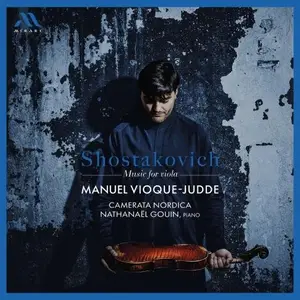
Manuel Vioque-Judde, Nathanaël Gouin, Camerata Nordica - Shostakovich / Music for Viola (2026)
FLAC (tracks), Lossless +Booklet |1:04:21 | 303 Mb
Genre: Classical
FLAC (tracks), Lossless +Booklet |1:04:21 | 303 Mb
Genre: Classical
Von den frühen Preludes bis hin zur Sonate op. 147 präsentiert uns Manuel Vioque-Judde ein authentisches Porträt des russischen Komponisten. Die Viola erweist sich auf der einen Seite als Filmheld, auf der anderen als geheime Stimme des unterdrückten Komponisten. Man kann das Album als Autobiographie, Krimi oder als Reisetagebuch durch die UdSSR von den 30er Jahren bis 1975 hören.
Ragazze Quartet, Slagwerk Den Haag, Kapok - Four Four Three: Music of Terry Riley (2016) Music
Posted by Designol at Nov. 4, 2026

Ragazze Quartet, Slagwerk Den Haag, Kapok - Four Four Three: Music of Terry Riley (2016)
EAC | FLAC | Image (Cue&Log) ~ 235 Mb | Mp3 (CBR320) ~ 134 Mb | Artwork included
Classical, Contemporary, Minimalism | Label: Channel Classics | # CCS37816 | 00:57:28
EAC | FLAC | Image (Cue&Log) ~ 235 Mb | Mp3 (CBR320) ~ 134 Mb | Artwork included
Classical, Contemporary, Minimalism | Label: Channel Classics | # CCS37816 | 00:57:28
The Ragazze Quartet with its classical roots, Slagwerk Den Haag with the sounds of today, and the idiosyncratic jazz trio Kapok… Contrasting contours, but a common denominator: none of our three ensembles belong to a specific category. All three push the boundaries of our genres in our quest for new forms and adventurous joint projects. It is through this inquisitive musicianship that the unusual combination feels so wonderfully natural. The choice for Riley’s repertoire gave another stir to our boundary reconnoitre. For Riley’s music allows considerable space for creativity and improvisation. The tension that arises through freedom within strict frames means that every performance is different. And it brings with it that the music has a strong sense of spontaneity and joie de vivre. In In C, performed by the Ragazze Quartet and Slagwerk Den Haag, the dynamic range is enormous. Long, melodic lines as well as short, rhythmic motifs may be employed, producing an effect of both tranquil contemplation and pulsating explosiveness. Sunrise of the Planetary Dream Collector was originally written for string quartet. But the Ragazze Quartet invited jazz trio Kapok to make a new arrangement together.The mix of string quartet and horn, electric guitar and percussion, all expanded with electronic effects, offers a rich pallet of timbres.
Chanticleer - William Byrd: Music For A Hidden Chapel (2004) Music
Posted by Designol at Nov. 4, 2026

Chanticleer - William Byrd: Music For A Hidden Chapel (2004)
EAC | FLAC | Tracks (Cue&Log) ~ 232 Mb | Mp3 (CBR320) ~ 127 Mb | Scans included
Classical, Renaissance, Choral | Label: Harmonia Mundi | # HCX 3955182 | 00:51:54
EAC | FLAC | Tracks (Cue&Log) ~ 232 Mb | Mp3 (CBR320) ~ 127 Mb | Scans included
Classical, Renaissance, Choral | Label: Harmonia Mundi | # HCX 3955182 | 00:51:54
Byrd, the chief musician of Elizabethan England, wrote and published liturgical music for clandestine religious observance. Among his most serene and pure works, these intimate five-voice masses are drawn from his second book of Gradualia published in 1607.
Cheyenne Symphony Orchestra & William Intriligator - American Landscape: Music of Jeff Lippencott (2026) Music
Posted by Fizzpop at Nov. 4, 2026
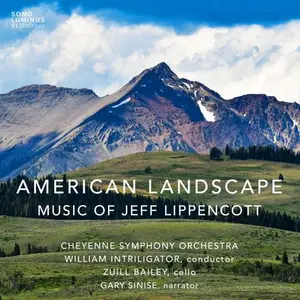
Cheyenne Symphony Orchestra & William Intriligator - American Landscape: Music of Jeff Lippencott (2026)
WEB FLAC (Tracks +Booklet) 214 MB | Cover | 57:21 | MP3 CBR 320 kbps | 144 MB
Classical | Label: Sono Luminus
WEB FLAC (Tracks +Booklet) 214 MB | Cover | 57:21 | MP3 CBR 320 kbps | 144 MB
Classical | Label: Sono Luminus
Pasturelands Cello Concerto was written in an accessible Americana style to highlight the picturesque settings of western grasslands and pastures of the United States. Composed in four movements, “Awakenings”, “Great Plains”, “Calves at Play”, and “Open Range”, this work expresses the daily and seasonal changes of God’s natural forces on the ranches and ranges of America. There is a beautiful simplicity of life lived on the prairies and plains of the American West. A rough, rugged, self-reliant spirit nurtures life, yet this spirit also relies on God’s seasonal elements to sustain it. From “Awakenings”, which opens the concerto as sunrise might open the day, to the fun and up-tempo third movement “Calves at Play”, Pasturelands urges the listener to enter into the simple yet ancient daily life of grazing cattle and fields full of swaying grasses.
Bavarian Radio Symphony Orchestra & Sir Simon Rattle - Stravinsky: The Firebird and Discover Music with Simon Rattle (2026) Music
Posted by ciklon5 at Nov. 4, 2026
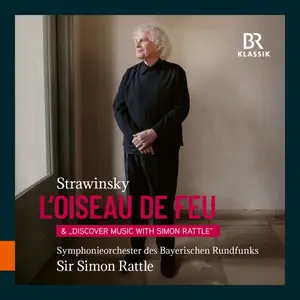
Bavarian Radio Symphony Orchestra & Sir Simon Rattle - Stravinsky: The Firebird and Discover Music with Simon Rattle (2026)
FLAC (tracks), Lossless | 1:14:11 | 270 Mb
Genre: Classical
FLAC (tracks), Lossless | 1:14:11 | 270 Mb
Genre: Classical
Igor Stravinsky's fairy-tale ballet "The Firebird" is rarely performed in its entirety in todays concert halls usually, only one of the concert suites is played. Simon Rattle performed the narrative ballet (composed in Paris in 1909/10 and premiered in 1910 by the famous Ballets Russes) in its full magnificence on November 6 and 7, 2025 with the Bavarian Radio Symphony Orchestra at the Isarphilharmonie in Munich. BR-KLASSIK is now releasing this recent concert recording on CD together with an edition of the new format "Discover Music with Simon Rattle".
The Queen's Six, The Rose Consort of Viols - Troubled Times. Music and Espionage in Renaissance England (2026) Music
Posted by ArlegZ at Nov. 3, 2026
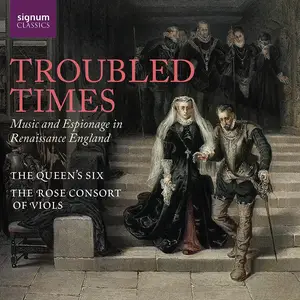
The Queen's Six, The Rose Consort of Viols - Troubled Times. Music and Espionage in Renaissance England (2026)
EAC | FLAC | Image (Cue & Log) ~ 284 Mb | Total time: 64:11 | Scans included
Classical | Label: Signum Records | # SIGCD978 | Recorded: 2025
EAC | FLAC | Image (Cue & Log) ~ 284 Mb | Total time: 64:11 | Scans included
Classical | Label: Signum Records | # SIGCD978 | Recorded: 2025
Troubled Times: Music and Espionage in Renaissance England explores the sacred music created during the religious and political turmoil of 16th-century England. Performed by The Queen’s Six and The Rose Consort of Viols, the programme examines how composers responded to censorship, exile, and shifting political loyalties from the Henrician Reformation through the Elizabethan era. Featuring works by composers including William Byrd and John Taverner, the recording reveals strategies of adaptation and survival within a climate of suspicion and religious conflict. By situating the music within its historical context, the project illuminates the intricate relationship between faith, political power, and artistic expression in Renaissance England.
Dmytro Kokoshynskyy - Music for These Troubled Times: Tallis, Byrd, Bull, Gibbons, Shalygin (2026) Music
Posted by ArlegZ at Nov. 3, 2026
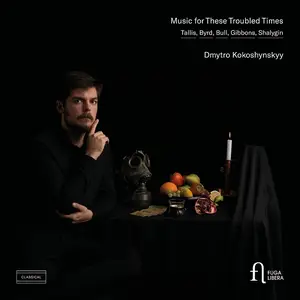
Dmytro Kokoshynskyy - Music for These Troubled Times: Tallis, Byrd, Bull, Gibbons, Shalygin (2026)
EAC | FLAC | Image (Cue & Log) ~ 530 Mb | Total time: 79:17 | Scans included
Classical | Label: Fuga Libera | # FUG 867 | Recorded: 2025
EAC | FLAC | Image (Cue & Log) ~ 530 Mb | Total time: 79:17 | Scans included
Classical | Label: Fuga Libera | # FUG 867 | Recorded: 2025
Music for These Troubled Times examines themes of melancholy, reflection, and resilience through the keyboard music of English virginalist composers from the late 16th and 17th centuries, connecting their emotional world to modern experiences of political instability, war, and uncertainty. Inspired by The Anatomy of Melancholy (1621), which presents music as a remedy for emotional distress, the program combines contemplative pavanes, inventive variations, and intricate polyphonic works with contemporary composer Maxim Shalygin’s KHORA. The recording also features rarely heard repertoire, including the premiere recording of the anonymous A Ground. Performed on three historically significant harpsichords modeled after instruments by Lodewijk Theewes, Ioannes Ruckers, and Henri Hemsch, the album emphasizes both historical authenticity and emotional immediacy.